Hitotsubashi Journal of Social Studies 32 (2000) pp 33-53
The Hitotsubashi
Academy TOKYO, JAPAN, December 2000
NATION, NATIONALISM AND CITIZENSHIP
IN THE FILIPINO WORLD WAR
II VETERANS
EQUITY MOVEMENT, 1945-1999
by SATOSHI NAKANO
The U.S. Immigration and Naturalization
Act of 1990, which contains a special provision giving "Filipino World War II veterans" the right to acquire U.S. citizenship
(Section 405, Pub. L. 101-649), soon brought about a large wave of elderly Filipino immigrants, twenty-eight thousand of whom
had became U.S. citizens by 1998.
The San Francisco Chronicle featured the patriotic moment of an oath-taking
ceremony held at the San Francisco Marriott Hotel in September 1992, where some five hundred newly naturalized Filipinos,
mostly in their 70s and 80s, proudly swore allegiance to the United
States (San Francisco Chronicle, 1992/9/25: A23).
In December 1993, however, the Chronicle reported a shocking story from Richmond, California, where seventeen Filipino
war veterans had been put in de facto captivity, locked up in houses owned by a man named Castalino Dazo, who called himself
a Filipino-American immigration and naturalization consultant, allegedly held the old men in virtual slavery by chaining,
beating, or otherwise abusing them as the occasion demanded (San Francisco Chronicle, 1993/12/19: A1).
Thanks to this article, the seventeen veterans were rescued the following
month by Contra Costa County local authorities and Filipino-American volunteers (Asian Week, 1994/1/28: 1). The veterans later
filed suit against Dazo and were granted damages (Filipino Express, 1995/3/5: 1). This incident, however, is just the tip
of the iceberg, as soon after the Richmond Incident, the L.A. Times and other major Pacific Coast newspapers began reporting
the sufferings of elderly and poverty-stricken
Filipino veterans throughout the region.
It also became known that in spite of the fact that they were
naturalized as recognized U.S. veterans, these Filipinos were not eligible for benefits from the U.S. Department of
Veterans' Affairs (hereinafter DVA), and thus had been
given little choice but to live on scanty Supplementary Security Income
(hereinafter SSI) payments. In November 1999, after years of consistent lobbying for equal treatment of Filipino veterans,
Congress finally passed a remedial bill called the "SSI Extension Act," which will be discussed in the final section of this
article.
The long struggle staged by Filipino veterans demanding equity in their
treatment by the United States has gone on for more than half a century, and derives from an unusual history of de-colonization
during and after World War II. Such a struggle may allow one to draw diverse or even conflicting conclusions regarding entangled
relationships between nation, nationalism and citizenship.
This article is an attempt to sketch the history of the Filipino WWII
veterans equity movement and discuss what historical lessons we can possibly learn from this life-long struggle for equal
recognition.
(1) An earlier version of this article appeared in Japanese as "Firipin-kei Beteran Sabetsu Zesei Mondai
no Hansciki," in lgarashi Takeshi (ed.), 2000, Amerika no Tarninzoku Taisei, Tokyo Daigaku Shuppankai, pp.215240. The author
would like to thank John Wisnom for his help with this English version, and is also deeply grateful to Barbara Gaerlan for
her collaboration in conducting the research on which this article is based.
------------------
PAGE 34 HITOTSUBASHI
JOURNAL OF SOCIAL STUDIES [December
I. The U.S. Veterans Benefits
Today in the United States, the principle
that "America will never forget nor abandon those who fought or fight for America" is indispensable in maintaining that country's
national integration and achieving military recruitment levels necessary to keep the nation as the world's one and only superpower.
Consequently, veterans benefits has thus naturally developed in step with America's emergence as a super military power.
The
"GI Bill of Rights" of 1944 is regarded as an especially commemorable step in that development by establishing a number of
new benefits, including educational financing. It is said "to have more impact on the American way of life than any law since
the Homestead
Act" of 1862 (http://www.va.gov/ About A/history/vafhis.htm).2 The
DVA numbers the veteran population
of the U.S. at 25.6 million as of July 1, 1997 and estimates the total population potentially eligible for veterans benefits,
including bereaved families, approximately at
70 million (http://www.va. gov/About VA/history/popstats.htm). 43.7 billion
dollars was allotted from federal budget for veterans affairs in 1999, and the DVA is currently the largest federal agency
next to
the Department of Defense://www.va.gov/pressrel/FSVA2000.htm).
The lion's share of federal spending for
veterans and their
families is used for education, death and disability compensation, old age pensions, burial costs,
and medical care, which would otherwise be categorized into social security and welfare spending.
However, it is financially important for the aged veterans,
especially those living in poverty, to receive the $722 a month payment granted to them in 1998 as veterans old age pensions
and free medical care at veterans hospitals throughout the nation and in many foreign countries. In contrast, the SSI payments
amounted to only $505 a month in 1998 (HCWM, 1999). It is also emotionally important
for many veterans to receive payments
not as welfare, but as an honorable reward for their past contributions to defending their country. In this sense, government
support for funeral and burial expenses (when necessary) are considered especially important for many veterans for securing
an honorable, dignified end to their lives. The government is also expected to provide plots in a national
veterans cemetery
and funeral flags, if requested.
According to the DVA, American flags distributed annually to veterans
funerals currently amount to 484 thousand (http://www.cem.va.gov/bflags.htm).
In principle, the benefits system for
U.S. veterans is
applicable regardless of nationality, provided that one is a former member of some branch of the U.S.
military. One important benefit for non-U.S. citizen veterans, which is not under DVA discretion, is a package of certain
privileges to acquire permanent residency or even
citizenship. Other veterans benefits in the narrow sense of those under
DVA discretion are also indiscriminately applied to foreign-born veterans who are citizens of 66 countries around the world
(HCVA, 1998, p.34).
II. Filipino World War II Veterans
Among the non-citizen veterans of the U.S. military,
only the "Filipino veterans of World War II" (hereinafter Filipino veterans) have been categorized into a separate benefits
status in (2) All of the URL addresses cited in this article were valid as of October 10, 2000.
-------------------------
2000] FILIPINO WORLD WAR II VETERANS EQUITY MOVEMENT [PAGE 35
both the above broad and narrow senses. Just
who are these "Filipino veterans" anyway?
Of the soldiers of Asian ancestry who served the United States on the battlefield
during World War II, the Japanese-American "Nisei" soldiers are probably the best known; but they are of course not the only
ones. Chinese-Americans and other people of Asian ancestry fought alongside Caucasian, Black and Latino soldiers during the
War, including the First Filipino Infantry Regiment, which was mostly composed of first-generation immigrants living along
the Pacific Coast who volunteered after the Japanese attack on Pearl Harbor in 1941 (Gonzalves, 1995). These Filipinos who
enlisted in the U.S. Army were to be granted U.S. citizenship if they so desired, and later many second-generation Filipino-American
soldiers joined the Regiment from Hawaii. All of them have received full veterans benefits since the time they were honorably
discharged from the military. They should therefore be thought of as Filipino-American, rather than Filipino, veterans, even
though some of them remained non U.S. citizens even after the War.
On the other hand, the Filipino veterans under
examination in this article have been defined under U.S. law as former soldiers, who were born in the Philippines and, unlike
the members of the Filipino Infantry Regiment, were residing in the Philippines when they enlisted in military service.
To be considered veterans of World War II, they are all required to have
served in active duty and been honorably discharged at any time between 1 September 1939 and 31
December 1946. They have
been further broken down into four general categories, the distinction of which has sometimes been both ambiguous and fluid.
The categories are (1) veterans of the Philippine Scouts, which was established in 1901 by the U.S. colonial government
as an auxiliary force, (2) veterans of the Philippine Commonwealth Army, which was established by the Commonwealth government
in 1935 as the future national defense force after the United States granted
independence scheduled for 1946, (3) veterans
of the recognized anti-Japanese guerrilla units in the Philippines active during the Japanese Occupation; (4) veterans of
the New Philippine Scouts, which was newly recruited by the U.S. Army after October 1945. Standing outside than these four
categories are a small number of Filipinos directly inducted into the U.S. Armed Forces.
Of the above four groups,
the Philippine Scout veterans are naturally closest to the status of U.S. military personnel in legal terms, since they were
directly recruited by the U.S. Army, while the New Philippine Scouts, most of whom overlap with the other three groups, were
recruited under special contracts that specifically limited their veteran status. The majority of the remaining "Filipino
veterans," however, belonged to the Philippine Commonwealth Army and the anti-Japanese guerrilla units, neither of which were
directly formed or recruited by the U.S. military. However, it is the Philippines' encounter with the Pacific War on the way
to national independence that makes their legal status a unique and controversial one.
In 1934, the U.S. Congress
passed the Philippine Independence Act of 1934, called the Tydings-McDuffie Act (48 Stat.463), which established a provisional
autonomous government (the Commonwealth) in the Philippines preparing full-fledged independence to be realized in 1946. The
Philippine Commonwealth Army was established on this occasion to assume responsibility for national defense after independence.
The same Act, however, still required all the citizens of the Philippines to pledge allegiance to the United States until
independence, and authorized the President of the United States to order the induction of the Commonwealth Army into the U.S.
Armed Forces at any time during pre-independence period. The latter provision made it possible for President Franklin D. Roosevelt
to order the Commonwealth
-----------------------------
PAGE 36] HITOTSUBASHI JOURNAL OF SOCIAL STUDIES [December
Army and U.S. Armed Forces stationed in the Philippines to be merged
in July 1941, forming the U.S. Army Forces
in the Far East
(hereinafter USAFFE) under the command of Douglas MacArthur.
After the Japanese invasion in December
1941, Filipino and
American troops literally shared the same fate at Bataan, Corregidor,
and the "Death March." In
May 1942, USAFFE Commander General Jonathan
Wainwright surrendered to the Japanese Army, but a considerable
number
of American and Filipino officers and enlisted men stationed
around the Islands refused to surrender and went on fighting.
Under
extremely severe occupation policies imposed by the Japanese, it was
not long before the anti-Japanese resistance
movement drew more and
more Filipinos to its side, as the Philippines became the stage for
most stubbornly fought
resistance movement in Southeast Asia. Through
1943 many of these anti-Japanese guerrillas recovered or newly
established
liaisons with the U.S. Army Command of the Southwest
Pacific Area and placed themselves under the command of General
Douglas
MacArthur, who personally pledged to liberate the Philippines
with his now famous "I shall return" statement.
Both
the U.S. and Philippine governments praised these
anti-Japanese guerrilla forces scattered all over the Philippine
Islands
as strategically indispensable to the Allied war effort in
the Pacific. On 28 October 1944, Commonwealth President Sergio
Osmena
issued Executive Order No.21 inducting "recognized guerrilla units"
into the Commonwealth Army.
This Order was generally understood as
inducting qualified guerrillas
into the U.S. Army, thus making them
eligible to receive military salaries and full veterans benefits,
since the Commonwealth
Army was then a part of the U.S. Army, whose
members were guaranteed salaries paid by the U.S. Army. Not
surprisingly,
many Filipinos in expectation of salaries and benefits
rushed to register as members of authorized guerrilla bands during
the latter days of the battle for the Philippines. When the war was
over, the Philippine Government was left with
the difficult and
hectic task of distinguishing in-earnest enlistees from the
"Johnny-come-lately" as well as establishing
a fair distinction
between "authorized" and "unauthorized" guerrilla groups. "Guerrilla
authorization" continued to
be a very serious political issue until
the end of 1948.
It should be noted here that Hukbalahap, the
anti-Japanese leftist
peasant guerrillas in Central Luzon that grew
out of the agrarian movement and thus exerted strong influence over
the
peasants population there, was not recognized in spite of its
outstanding contribution to winning the war for the Philippines.
Although there are no official statistics, the figure 200,000 has
often cited as a rough estimate of the total
World War II Filipino
veteran population that survived the War (HCVA 1998, p.26). Of that
number, 12,000 belonged
to the "old" Philippine Scouts and 120,000
were "original" members of the Commonwealth Army (Asian Week,
1997/11/19:
13). The remainder, or around 70,000 persons, were
members of authorized guerrilla groups and the New Philippine Scouts.
As military personnel, all of them had sworn allegiance to both the
U.S. and Philippine governments. They considered
these two
allegiances as entirely compatible with each other and they risked
not only their lives but also those of
their families, not to mention
their native soil, for an ultimate U.S. victory. More than 1.1
million Filipino people
lost their lives during the War, more often
as victims of Japanese atrocities, but also in bombardments by U.S.
heavy
artillery. The physical damage done by the War is estimated as
$ 5.8 billion in 1950 prices (Nakano 1997, pp.278-9).
Given
such facts and figures, the Filipino veterans have good
reason to believe that they deserve U.S. veterans benefits as
much as
anyone else. After the War, however, they met with
------------------------------------
2000]
FILIPINO WORLD WAR II VETERANS EQUITY MOVEMENT [PAGE 37
the stark reality that among theforeign U.S. military veterans
of 66
countries, only they would be discriminated against in veterans
affairs. The first proof of this was the denial
of veterans
immigration privileges to them.
III. The Denial of Immigration Privileges
Before the outbreak
of Pacific War, the Asians had been an
explicit object of racial discrimination under U.S. immigration and
naturalization
law, which declared all new comers or first-generation
immigrants of Asian ancestry ineligible for U.S. citizenship. This
unequal treatment was abolished with regard to the Chinese in 1943,
Indians and Filipinos in 1946, and the Japanese
and others regardless
of national/ethnic origins in 1952. Even before the War, however,
there were two ways open for
the Asians to acquire U.S. citizenship.
One was the principle of "citizenship by birth" derived from the
Fourteenth
Amendment to the Constitution (U.S. vs. Wong Kim Ark,
1898); the other was citizenship under U.S. veterans immigration
privileges.
The former way embraces the idea that attaches importance
to qualification
as a citizen of the republic over any rights
attained by birth and being raised in the United States over one's
national
or ethnic origins. The latter way place utmost importance on
loyalty to the United States shown by risking ones' life
in military
service, especially on the battlefield. Both may well be a reflection
of the ideological disposition of
the U.S. citizenship system.
There are two kinds of immigration privileges given to
foreign-born U.S. military
veterans: one for military personnel in
general, and the other is for those who have served in wars. The
latter loosens
the conditions of naturalization more than the former.
In the case of World War II veterans, on 27 March 1942 Congress
enacted the Second War Powers Act (Pub. L. No.77-507, 56 Stat. 182),
a section of which amended the Nationality Act
of 1940 (Pub. L.
No.76-853, 54 Star. 1137) to provide for the naturalization of
non-citizens serving in the U.S. Armed
Forces "during the present
war."
The law exempted certain non-citizen servicemen from some of the
usual naturalization
requirements, such as a specified period of
residence in the United States or literacy and educational testing in
English.
The law also enabled those servicemen presently on active
duty in the U.S. military to be naturalized without appearing
before
a naturalization court in the United States and directed the
Commissioner of the Immigration and Naturalization
Service
(hereinafter INS) to send authorized officers to overseas military
posts to do everything necessary to naturalize
noncitizen members of
the U.S. Armed Forces on the spot. The cut-off date for applying for
such privileges was later
set at 31 December 1946 (Ch. 199, 56 Stat.
182).
According to the official accounts, which were later submitted
to
the court, the law was at first interpreted by the U.S. Government as
applicable to the Filipino veterans. On 1
August 1945, the INS
authorized George H. Ennis, Vice Consul of the United States
stationed in Manila, to naturalize
alien servicemen in the Philippine
Islands pursuant to the law. Immediately after his appointment,
however, the Philippine
Government repeatedly "expressed to the
Department of State its concern" regarding the risk of a mass
emigration of
newly naturalized Filipinos to the United States, which
would be harmful to its postwar reconstruction efforts. In response
to this official concern on the part of the Philippine Government, on
13 September INS Commissioner Ugo Carusi proposed
cessation of
conferring citizenship in the Philippine Islands to Attorney General
Tom C. Clark, who on 26 September
revoked the authority
------------------------
PAGE 38] HITOTSUBASHI JOURNAL OF SOCIAL STUDIES [December
previously
granted to the Vice Consul at Manila. The decision was
received by Ennis on 26 October. Since the INS knew the situation
was
"rather anomalous," on 1 August 1946, soon after the independence of
the Philippine Republic, they sent P. J.
Phillips as an authorized
officer to naturalize alien servicemen in the Philippine Islands.
Some 4,000 Filipinos applied
and were granted U.S. citizenship by the
end of the year.3
These official accounts have been generally accepted
as facts in
later naturalization suits, but several questions remain unclear.
Strangely enough, the official who conveyed
the fear on the part of
the Philippine Government for mass emigration has yet to be
identified. The official explanation
is also very questionable for it
attributes cessation of conferring U.S. citizenship only to the fear
of another government
and justifies the policy as a simple response
to their request.
The United States at that time was still acting
under the very
restrictive immigration and naturalization laws enacted in 1924,
which practically forbade immigration
of Asians categorized as
"aliens ineligible for citizenship." Filipinos, as U.S. nationals
under the American colonial
regime, were exceptions and free to
immigrate, but faced severe racial discrimination and a strong
exclusion movement
in the Pacific Coast region during 1920s to 30s.
Then Filipino immigration was virtually stopped in 1934 by the
above-mentioned
Tydings-McDuffie Act, which defined Filipinos as
resident aliens and set an annual immigration quota of fifty (Nakano,
1989; Hing, 1993, pp.62-63).
In addition, the postwar mass demobilization and repatriation of
young soldiers
was expected to cause a serious unemployment problem,
or "Government Issue," which is the origin of the term "GI." Under
these circumstances, it is very unlikely for the U.S. Government to
have been unconcerned about a possible mass migration
of Filipinos,
even if the immigrants were veterans of the U.S. military.
Certain State Department records show
that Vice Consul George
Ennis may not have accepted any Filipino applicants because he
thought it necessary to avoid
mass emigration and made a strict
interpretation of the 1942 Second War Powers Act. His logic was that
"a resident
of the Philippine Islands" could not be qualified because
the law required the applicant to have been at the time of his
enlistment or induction a resident of the United States, or who was
lawfully admitted into or entered the United States,
including its
territories and possessions prior to 1 September 1943.4
In September 1945, the INS repealed this narrow
interpretation and qualified Filipino veterans as eligible
for immigration privileges. However, the repeal is assumed
to have reached Ennis
almost at the same time as his
authorization as
a naturalization officer was revoked
[Olegario v. U.S., Note 5, 629 F.2d 204 (1980)].
Such authorization
was resumed in August 1946, as mentioned
above, but the INS still refused to accept applications from members
of the
Commonwealth Army and authorized guerrilla units, who
constituted the majority of all possible applicants. Refusal was
based on the "Rescission Act" of February 1946 withholding the right
to receive veterans benefits from those falling
into these two
categories.
Later the INS was forced to abandon this narrow interpretation
once again, when
in a 1957 naturalization suit, the court denied the
legality of applying the Rescission Act to immigration policy
[Petition
for Naturalization of Munoz, 156 F.Supp. 184 (1957)]. These
facts seem to indicate that despite the appointment of two
(3) Ugo Carusi, Commissioner, INS, to Tom C. Clark, Attorney
General, September 13, 1945; Edward J. Shaughnessy,
Special Assistant
to the Commissioner of the INS, to Ugo Carusi, October 19, 1945.
Quoted in 629 F.2d 204 (1980).
(4) George Ennis, "Memorandum," August 7, 1945. 811B.00/8-1345.
State Department Central Files, 1945-1949. RG59, NARS.
__________________________
2000] FILIPINO WORLD WAR II VETERANS EQUITY MOVEMENT [PAGE 39
authorized
naturalization officers, the U.S. Government deliberately
controlled the acceptance of veterans' applications for
naturalization
based on legal interpretations that would be overruled
later.
It was in the middle of 1960s, after almost twenty
years after
the cut-off date for application, that Filipino veterans finally
began their struggle to recapture the
immigration privileges once
denied them. One may ask why it took so long to launch this campaign.
There seems to be
several reasons. From 1947, after the cut-off date,
they should first go to the United States and appear in
naturalization
court to file applications. In 1952, Congress formally
abolished the special naturalization clauses in the 1942 Second
War
Powers Act and they should have been ready for filing naturalization
suits from the beginning but most of the
veterans who wanted to
exercise their immigration privileges lacked both education and
financial sources. It was not
easy for them to come and stay in the
United States to sit through a long lawsuit.
However, the situation was
dramatically changed by the 1965
Immigration Act, which abolished the national quota system and opened
the door for
immigrants through familysponsored and employment-based
preferences. The new immigration law was advantageous for Filipinos,
who possessed similar and compatible educational and licensing
systems transplanted from the colonial period and had
plenty of
immediate relatives who had come to the United States in recent
years. Since the late 1960s, Filipino immigration
to the United
States has been constantly recording a figure only second to Mexican
immigrants.
These new circumstances
may have re-stimulated the desire to
emigrate among the Filipino veterans, who were already in their
middle years,
and made it much easier for them to come to the United
States using family-sponsored preferences, in the case their children
or immediate relatives had immigrated previously, to obtain permanent
residency or citizenship. The INS, however,
dismissed all application
of Filipino veterans submitted twenty years after the cut-off date.
Therefore, the issues
were finally ready to be argued in court.
IV. Twenty-four Years of Naturalization Suits
The first Filipino
veteran to petition in a naturalization suit
was Hibi, a pioneering plaintiff of sorts, since he entered the
United
States in 1964 on a visitor-for-business visa and filed for
naturalization before the enactment of new immigration law.
Hibi
complained that the government had failed to inform him about the
right to naturalization and to provide authorized
personnel while he
was eligible for naturalization, arguing that since these actions
violated his rights, the Court
should now grant his petition for
naturalization.
In 1967, U.S. District Court of Northern District of California
agreed with his contentions, and its decision was upheld by the Court
of Appeals for the Ninth Circuit. However, in
October 1973, the
Supreme Court summarily reversed the decision without hearing oral
argument in the case, finding
that the INS' administration of the Act
did not constitute "affirmative misconduct." The Court never directly
decided
whether "affirmative misconduct" could estop the government
from reliance on the expiration date and thus justify it to
grant his
petition for naturalization. Three justices including Thurgood
Marshall dissented and criticized the decision
for ignoring "the
deliberate - and successful - effort on the part of agents of the
Executive Branch to frustrate
the congressional purpose and to deny
substantive rights to
----------------------------------
[PAGE 40]
HITOTSUBASHI JOURNAL OF SOCIAL STUDIES [December
Filipinos" [INS v. HiBi, 414 U.S. 5 (1973)].
Because INS
v. Hibi failed to establish definitive criteria as a
precedent case, lower courts continue to decide on petitions by
relying
on case-by-case comparisons, and thus reach diverse
conclusions. Among them the most noticeable case is Naturalization
of
68 Filipino War Veterans [406 F. Supp. 931 (1975), hereinafter 68
Veterans] in December 1975. In this class action,
the U.S. District
Court of Northern District of California again decided in favor of
the Filipino veterans.
The
Court classified sixty-eight petitioners into three
different categories, which would continue to play a significant role
in cases that followed. First, seven petitioners were classified as
Category I veterans, who submitted applications
or pursued
naturalization while they were eligible under the Act. The Court
found that the government actions against
Category I veterans
constituted "affirmative misconduct" and ruled that their petitions
should be granted.
Then
the Court classified fifty-three petitioners as Category II
veterans, who were eligible under the Act, but took no steps
to be
naturalized prior to 31 December 1946. Of the vast majority of the
Filipino veterans placed into this category,
most of them were
ignorant of their right to naturalization at the time because both
the U.S. and the Philippine Governments
gave out virtually no
information about it. Moreover, since the process of registering
authorized guerrilla groups
was not completed until the end of 1948,
most veterans falling into that category did not have authorization
to exercise
their right even if they knew about it.
With regard to these Category II veterans, the District Court
examined
to what extent the petitioners should be protected by the
due process clause in the Fifth Amendment of the U.S. Constitution.
Although the Philippines established its own government and
constitution in 1935 and would soon to be an independent
foreign
country, the petitioners, as the citizens of the Philippines,
continued to owe allegiance to the United States
during the relevant
time period and in fact were "loyally defending this country through
service in our armed forces."
The Court found that the petitioners were therefore entitled to
the same judicial determination of their constitutional
claim as
"resident non-citizens" of the United States. Here the Court,
interestingly enough, referred to Korematsu
v. United States [323
U.S. 214 (1944)] and other decisions regarding the constitutionality
of Japanese interment camps
during the War, emphasizing that only the
presence of "circumstances of direct emergency and peril" or the
grave "danger
of espionage and sabotage, in time of war and of
threatened invasion" could justify governmental action of
discrimination
based on alienage or ethnic origin. Since the concern
for the maintenance of amicable relations between the United States
and the Philippines was, even if it is reasonable, insufficient
justification for violating petitioners' rights, the
Court ruled that
Category II veterans' petitions should also be granted.
The remaining eight petitioners were
classified as the Category
III veterans, who were unable to show that they had served in the
U.S. Armed services.
The Court also granted their petitions with
condition that they should provide proper evidence of their
eligibility
within 90 days of the decision.
The U.S. Government's reaction to the decision wavered between
appeal and acceptance.
After the decision, the INS immediately filed
an appeal, but Lionel Castillo, the newly appointed INS Commissioner
under
Jimmy Carter's Democratic administration, ordered the appeal
revoked on 30 November 1977, stating that such a course "would
be in
keeping with the
(5) Naturalization of 68 Filipino War Veterans, 406 F. Supp. 931
(1975), p.950.
_________________________________
2000] FILIPINO WORLD WAR II VETERANS EQUITY MOVEMENT [PAGE 41
policy of the [new] Administration," described
as "a course of
compassion and amnesty."6 Afterwards, however, the INS 'changed its
policy again and decided only
to accept without reservation Category
I veterans' applications, while only Category II veterans'
applications filed
before 30 November 1977 would be accepted to avoid
being swamped with new applications.
As naturalization suits
between new petitioners and the INS
resumed, the Association of Immigration and Nationality Lawyers
demanded the application
of offensive collateral estoppel, stating
that once the INS revoked their appeal in 1977, the 68 Veterans
became a
final decision, so the petitioners could estop the
government from re-litigating the constitutional issues decided in
68
Veterans.
The INS argued that collateral estoppel would be grossly unfair
and that their policy revision
could be justified in view of
unexpected repercussions to the consequences of the 68 Veterans
decision. In Olegario
v. United States [629, F.2d 204 (1980)], the
Second Circuit Court accepted the government's argument and dismissed
the
Filipino veterans' petition; but in 1984 the Ninth Circuit in
Mendoza v. United States [672 F.2d 1320 (1984)] found that
the issue
involved in Filipino veterans' cases were not of such great
significance as to create a crucial need for
the government to
relitigate the issues, and approved the application of offensive
collateral estoppel. Because all
the lower court decisions showed
substantial differences and conflicts in their opinions, the time had
come for the
Supreme Court to settle the issues.
The Court first responded in 1984 with United States v. Mendoza
[464 U.S.
154 (1984)], which denied the application of offensive
collateral estoppel in such cases as the Filipino veterans, in
which
a litigant (petitioner) was not a party in the first suit. The
decision in effect undid 68 Veterans as a final
decision (Sherman,
1985). Then in 1988, the Supreme Court put an end to years of
Filipino veterans naturalization
suits with INS v. Pangilinan [486
U.S. 875 (1988) ]. The decision held that neither the application of
collateral
estoppel, nor by invocation of equitable powers, "nor by
any other means does a court have the power to confer citizenship
in
violation of the limitations imposed by Congress in the exercise of
its exclusive constitutional authority."
The
Court also rejected the possibility of a violation of equal
protection, since the approximately seven-month presence of
a
naturalization officer not only met the applicable standard of equal
protection but indeed compared favorably with
the merely periodic
presence of such officers elsewhere in the world. It held that "the
historical record does not
support the contention that the actions at
issue here were motivated by any racial animus."
INS v. Pangilinan
rather forcibly closed the door in the face a
further litigation by the Filipino veterans by siding entirely with
the
government's argument. However, the unanimous opinion joined by
justices having dissented in INS v. Hibi was also tacitly
sending a
message to the U.S. Congress that "the congressional command here
could not be more manifest." In sum, the
Court's opinion said that it
should be the Congress to correct the law if it was wrong, since the
Filipino veterans'
right was explicitly deprived by Congressional
acts (Murphy, 1988). The U.S. judiciary thus gave the Filipino
veterans
their final answer after having spending twenty-four years
in litigation from the time Hibi filed his application for
naturalization.
6 Quoted in U.S.v. Mendoza 464 U.S. 154 (1984).
________________________________
[PAGE
42] HITOTSUBASHI JOURNAL OF SOCIAL STUDIES [December
V. The 1990 Immigration Act
The U.S. Congress quickly
responded to INS v. Pangilinan.
Although there were no congressmen or senators of Filipino ancestry,
such members
as Senator Daniel Inouye (Democrat, Hawaii), and
Congressmen Tom Campbell (Republican, California) and Benjamin Gilman
(Republican, New York) sponsored Filipino veterans naturalization
bills. House Hearings were held on 21 September
1989, at which the
government made no argument against the issue (HCJ, 1990).
The bill to permit Filipino veterans
special naturalization was
then incorporated into the 1990 Immigration Act, which became law in
November 1990. One
may wonder how the U.S. Congress was able to solve
the issue so easily.
The implicit message to it in the Supreme
Court decision may
have been clearly received and understood. The timing may also have
been very appropriate for this
kind of single-issue bill to be passed
as a built-in to the omnibus immigration Act. The favoritism shown by
George
H.Bush's Republican administration towards veterans issues may
also have helped to establish bipartisan support for the
bill.
However, time was probably a more decisive factor than anything
else. The majority of the Filipino veterans
had already reached their
70s around the year 1990, and their population was steadily
diminishing. At the 1989 House
Hearings, Congressman Campbell
emphasized "It's unlikely that many of these veterans will choose to
move to America
in the twilight of their lives. Rather, they will
choose to remain in their homeland with family and friends (Ibid.,
p.44)."
In other words, aging and dwindling numbers made it possible for
the U.S. Congress, which had once closed the
door to Filipino
veterans, to settle the issue as "a matter of justice and honor."
It is also very important that
the sponsors of the bill tried to
separate the naturalization issue from other veterans benefits equity
issues. At
the same Hearings, Campbell stated that giving these
veterans citizenship will not "make them eligible for federal
benefits
which they do not already receive (Ibid., p.43)." The 1990
Immigration Act also spelled out that the law "shall not be
construed
as affecting the rights, privileges, or benefits of" Filipino
veterans coming to the United States (Section
405, Pub. L. 101-649).
Later developments would lead to criticism leveled at
unawareness on the part of Congress
of the possible serious
consequences of aged veteran immigration invited by this legislation,
while one is impressed
with the ideological disposition concerning
citizenship shared throughout U.S. society allowing aged veterans
from
the Philippines naturalization regardless of numerous concerns.
It was one of the best moments in the life of Patric
Ganio, a
Filipino veteran fighting for the restoration of his benefits, when
he attended the 29 November 1990 White
House ceremony where President
George H. Bush signed the 1990 Immigration Act. From the time he had
immigrated to
the United States sponsored by his daughters who
previously immigrated using employment-based preferences as nurses,
Ganio
had been lobbying for a naturalization act, while working as a
lobby operator in a tiny building in Washington, DC. It
was certainly
a triumph of justice and honor for him, since he himself had acquired
U.S. citizenship without having
to rely on veterans naturalization
privileges.(7) The "promise kept" after almost a half-century,
however, would soon
be articulated with the realities of Philippine
society and
(7) Interview with Patric Ganio (President, ACFV),
August 13, 1999.
_________________________________
2000] FILIPINO WORLD WAR II VETERANS EQUITY MOVEMENT [PAGE
43
cause a wave of elderly "adventurous" veteran immigrants far beyond
expectation.
Soon after the 1990
Immigration Act came into effect, the book
titled How the Filipino Veteran of World War H Can Become a U.S.
Citizen
(Lewis, 1992) appeared on shelves of bookstores in the
Philippines. Though the author duly pointed out there would be
many
risks and advised veterans to deliberate the advantages and
disadvantages of applying for U.S. citizenship, the
publication of
this kind of how-to book was a reflection of the emigration fever
expected to spread among veterans.
The fever was remarkable indeed.
By 1998, over twentyeight thousand out of seventy thousand surviving
veterans eligible
for immigration privileges became naturalized and
some seventeen thousand veterans came to live in the United States
(HCVA,
1998, p.192).
Why did these people already in their 70s want so much to become
Americans? In interviews appearing
in newspaper articles on veteran
naturalization, most probably conducted in English, the Filipino
veterans spoke in
unison about their joy of being recognized as
veterans and realizing their "dreams" of becoming citizens of the
United
States, the country which they had loved since their childhood
(Los Angeles Times, 1992/2/2: B1). However, it was unlikely
that they
wanted to be naturalized only for the sake of becoming Americans. A
Filipino American journalist at the
San Francisco Chronicle, being a
recent immigrant himself and apparently capable of conducting
interviews in Tagalog
and/or other native Philippine dialects, was
successful in capturing the real voices of these aged veterans, who
were
enduring poverty and other difficulties of everyday life in the
United States in order to apply for immigrant visas for
their
families or reducing their living expenses to send home a part of
their SSI allotments. Most had come to the
United States to open a
way out of poverty for their families in the Philippines (San
Francisco Chronicle, 1997/12/14:
Z1).
One can hardly deny that the Philippines is still a poor country,
even though its economy seems to have bottomed
out from years of
economic slump. Per capita income was only $1,184 even before the
Asian economic crisis of 1997
(HCVA, 1998, p.255). On the other hand,
Filipino Americans, which numbered 1.4 million in the 1990 census,
are one
of the most economically successful ethnic groups in the
United States. Although their per capita income in 1989 ($13,616)
was
slightly under the national average, they have highest ratio of
employed workers to total population (75.4%) and
more employed
persons per household (29% of total households had more than three
working persons, which is more than
twice of the national average).
Therefore, average income per family was $46,698, which is 30%
higher than the
nation's average. Their poverty rate (6.4%) was even
less than Japanese Americans and much under the nation's average
(13%). In addition, the ratio of those who were born in the
Philippines to total population is very high (64%, 0.91
million),
almost half of them entering the United States during the 1980s
(USBC, 1993; 1993a). These figures show
that Filipino income is very
high, considering most entered the country rather recently, meaning
emigration to the
United States can probably provide the average
Filipino family with a rapid increase of its standard of living.
The
lure of America is also shown in the following figures. As of
January 1997, Filipino applicants for U.S. immigrant visas
amounted
to 0.57 million, second only to Mexican (1.05 million), out of a
total of 3.62 million around the world (U.S.
Dept. of State, Bureau
of Consular Affairs, 1997). Though the duration of waiting for
admission depends on which category
of immigrant visa one applies
for, it may take more than ten years if we calculate a simple average
based on the annual
admission quota for Filipino immigrants of around
50,000.
_________________________
[PAGE 44] HITOTSUBASHI
JOURNAL OF SOCIAL STUDIES [December
Furthermore, applicants are usually required to have designated
skills or
immediate relatives possessing permanent residence or
citizenship if they want to use any preferential categories. This
means there may be many more Filipinos who want to apply, but don't
because they are currently unable to satisfy the
conditions for such
preferential categories. It is therefore no wonder why the
immigration privileges given to Filipino
veterans seem like such a
dream story. Especially for those who do not have immediate relatives
in the United States,
fathers or grandfathers who are World War II
veterans suddenly become angels leading their family to heaven's
gate.
A number of Filipino veterans who are spending their twilight
years in exile came to stay in the United States in order
to meet the
expectations of their families waiting for exodus out of poverty.
However, life for Filipino veterans
in the United States has been
hard beyond expectation and their immigration fever has been fully
exploited by crooks.
For many of the Filipino veterans had neither
enough legal knowledge nor savings to come and stay in the United
States,
immigration agents willingly take care of them and even
advanced money for their voyage and accommodations. This is good
business even if the veterans have no prospect of income after
settling in the United States, since the agents can
lend them money
at high interest rates holding a mortgage on their SSI checks, which
are payable to the bearer on
demand (Los Angeles Times, 1995/1/1: B1;
Sacramento Bee, 1995/8/20: A10). Such crooks as Castalino Dazo,
mentioned
at the beginning of this article, even turned to locking up
veterans in order to secure their SSI checks.
Even
if they have not been victimized by crooks, most aged
veterans have had to face common financial difficulties. It was
indeed surprising to many veterans that they were not eligible for
such U.S. veterans benefits as old age pensions
or Medicare, in spite
of the fact they acquired citizenship as veterans. Without any other
means of support, they
cannot but depend on SSI allotments. One more
catch is that as long as they depend on SSI, they are not eligible to
sponsor
their immediate relatives, even their wives, for immigration
status. Even for those who are eligible as sponsors, it will
surely
take several years for their families to receive immigrant visas.
As of September 1999, Filipino immigrant
visas for
family-sponsored categories were finally being issued to those who
applied twelve years previous, both in
cases of married and unmarried
children. Though there is no limitation for admission of spouses and
children under
twenty years of age, sponsors have to provide a
certificate of income showing amounts at least 20% more than the
federal
poverty line (U.S. Dept. of State, Bureau of Consular Affairs
1999). If a veteran dies before all this paper work is processed,
all
his efforts will end in vain.
The U.S. Congress, facing such an "unexpected" situation, has
passed several
bills to amend the Immigration Act, making it possible
for veterans to naturalize in the Philippines and extending the
cut-off date for application, currently to February 2001, in order to
prevent such risky voyages by aged veterans
to the United States (8
CFR 329.5). As a result of these measures, more than ten thousand
veterans have applied for
naturalization in the Philippines. However,
the vast majority of the naturalized veterans residing in the United
States
have not gone back to the Philippines, while more veterans
have emigrate to the United States after being naturalized
in order
to receive SSI benefits (San Francisco Examiner, 1993/12/19: B5).
Since prospects of certain remedial bills
regarding veterans benefits
are looking up in Congress recently, most veterans have chosen to
stay in the United States
to await the outcome.
-------------------------------
2000] FILIPINO WORLD WAR II VETERANS EQUITY MOVEMENT
[PAGE 45]
VI. The Veterans Benefits Issue and Postwar Philippine-U.S. Relations
Like the immigration benefits
issue, discriminative status
regarding financial benefits for Filipino veterans in the United
States dates back to
the end of World War II. In September 1945, the
then Federal Bureau of Veterans Affairs officially stated that
Filipino
veterans were eligible for the U.S. veterans benefits (USHC,
1947, p.65). However, in February 1946, Congress passed a
section of
the Supplementary Appropriation Rescission Act of 1946 that stated
services in the Philippine Commonwealth
Army or authorized guerrilla
units "were not to be considered as active military service for the
purposes of veterans
benefits." However, members of the Philippine
Commonwealth Army had already paid a certain amount from their
salaries
for the purpose of veterans insurance, which would be paid
in the form of serviceconnected survivor's pensions and disability
pensions in case of their death or disablement.
Regarding these pensions, Congress enacted that these pensions
should be paid, but only at half their value; that is, as if one
dollar were equivalent to one Philippine peso at
a time when one U.S.
dollar was equivalent to two pesos. Although the Rescission Act has
been amended several times,
its basic provisions still stand (38 USC.
107). Since the Act distinguishes veterans not by nationality but by
specific
military career during the war, according to which military
organization they belonged to, Filipino veterans would still
not be
eligible for full benefits, even if they changed their nationality
and became U.S. citizens.
As mentioned
in Section III, despite the fact that an officially
authorized naturalization officer was present in Manila from August
to December 1946, the INS rejected applicants who had been denied
veterans benefits under the Rescission Act, which
means they accepted
only applicants from the "old" Philippine Scouts. Therefore, the
contradiction between the Rescission
Act and immigration privileges
did not surface in the United States until the 1990s.
Therefore, for decades the
veterans benefits equity issue was
exclusively the concern of Filipino veterans in the Philippines, who
were demanding
the repeal of or revisions in the Rescission Act.
There was also fierce reaction expressed in Filipino public opinion
to the insulting nature of the Act, which states that fighting
against the Japanese during the War was "not to be
considered as
active military service" and cut pension payments in half. U.S.
Government was also concerned that the
issue may jeopardize
post-colonial Philippine-U.S. relations. President Harry S. Truman
stated on the occasion of
signing the Rescission Act "they fought
with gallantry and courage under the most difficult conditions during
the
recent conflict" and "I consider it a moral obligation of the
United States to look after the welfare of the Filipino
Army
veterans," promising the matter would be deliberated by the two
governments (USHC, 1947, pp.65-69).
The
manner in which Congress passed the Rescission Act may have
been influenced by other bills under consideration to finance
the
post-independent reconstruction of the Philippines. The Philippine
Rehabilitation Act, enacted in April 1946,
authorized appropriations
of $620 million, while the Rescission Act itself was combined with an
appropriation of $200
million to pay unpaid salaries to Filipino
veterans. There was a deep-rooted feeling in Congress against further
federal
spending for the Philippines, since it would soon to be
politically independent from the United States. All through the
colonial period, Congress had tended to be paternalistic in attitude,
considering the U.S. possession of the Philippines
to be an economic
liability rather than a strategic asset. In the legislature's view,
the United States had
--------------------------------
[PAGE 46] HITOTSUBASHI JOURNAL OF SOCIAL STUDIES [December
always been too generous a donor, and the Philippines
an insatiable
recipient.
The Philippine-U.s. government-level talks on veterans affairs,
which 'began with
the Truman's promise, were to drag on for many
years. Immediately after the enactment of the Rescission Act, the two
governments
agreed that the U.S. side would consider providing
medical care and funeral benefits. In 1948, Congress approved the
construction
of a veterans hospital in Manila (62 Stat. 1210). The
Philippine Government and Congress then decided to provide the kind
of veterans benefits not being provided by the U.S. government, but
at reduced rates, with the passage of the Philippines
GI Act (78
Phil.Code $$1-15).
However, the Philippine Government soon fell into chronic fiscal
trouble and,
becoming hard-pressed to maintain the benefits system,
repeatedly asked U.S. Government for assistance to finance the
system
in addition to a number of other fiscal requests.
In 1950, the U.S. Government, frustrated by the repeated
financial requests by President Elpidio Quirino's administration,
whose corruption and financial irresponsibility
had became a serious
issue between two governments, actually threatened to end assistance
for veterans benefits.~
The Philippine Government, however, did not
withdraw its demand all that easily and in 1951 funeral benefits and
burial
flags were provided (65 Stat. 32-33; Meyer, 1965, pp.18-20,
43-44, 100-101).
In 1962, further economic crisis
and inflation made it
impossible for the Philippines to maintain its exchange rate, as the
peso was devaluated from
2 to 3.9 pesos to the U.S. dollar. This
resulted in a sharp decrease in World War II veterans survivor and
disability
pensions, which were paid at the rate of one peso to the
U.S. dollar. Then the Philippine Government demanded that the
calculation be changed from one-peso-to-the-dollar to
fifty-cents-on-thedollar. The U.S. Government met President
Marcos'
demand in 1966, out of a desperate desire of "more flags" to join and
support the U.S. struggle in the Vietnam
war, and later Congress
enacted a revision of the calculation, which stands at the present
day. The two countries
also continued to discuss such issues as the
maintenance of Manila Veterans Hospital.
The veterans benefits issue
is therefore different from the
immigration privilege issue, since the former was hammered out
through plenty of bilateral
government talks and congressional
actions. Through this process, the consensus between the two
governments about
the unfairness of the Rescission Act gradually
faded away, and the U.S. Government also came to consider the issue
as
just one more an item of Philippine Government's endless demands
for assistance, putting it in the context of the paternalistic
image
of the United States as permanent donor and the Philippines as
permanent goodwill-seeker.
VII. The Filipino
Veterans Equity Movement:
The Emergence of a Civil Rights Issue
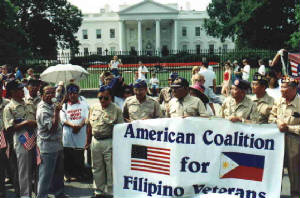
During the 1990s, the Filipino veterans benefits
issue was
revived in a quite unexpected way. The new turn taken is symbolically
represented by a demonstration staged
in front of the
White House on 12 July 1997. Before loud applause and cheers, elderly
Filipinos in veteran's uniforms
and caps marched in parade shouting
such slogans as "WE ARE AMERICAN CITIZENS! ....WE WANT JUSTICE! ....
EQUITY NOW?'
Then a dozen of them chained themselves to the iron
fences in front of the White House Garden, being joined by young
(8)
The Secretary of State to the Ambassador of the Philippines,
March 13, 1950. FRUS, 1950, Volume VI, pp. 1419-1422.
________________________________
2000] FILIPINO WORLD WAR II VETERANS EQUITY MOVEMENT [PAGE 47]
Filipino American activists as well as Congressman
Bob Filner
(Democrat, California). All of them were soon gently arrested by the
police. The sensational nature of
the scene and the fact that a
Congressman was arrested made the demonstration a must for major TV
network news programs
that evening (ACFV, 1999).
The above scene demonstrates that the destitute claimants for
benefit equity, who appeared
on the TV screen and from that time on
before the U.S. Government and Congress, are Filipino veterans who
are at the
same time U.S. citizens. In other words, the issue
suddenly turned into a civil rights matter, in which the essential
equality of citizens in U.S. society became the focus.
Congressman Bob Filner's involvement is a clear sign of
this
change. Filner is a "veteran" of the Freedom Rides of 1961, who wrote
an important page in Civil Rights Movement
during the era of Martin
Luther King. After teaching history at San Diego State University for
more than twenty years,
Filner ran for Congress in the 50th
Congressional District of California and was elected in 1992, two
years after
the enactment of the 1990 Immigration Act. His district
covers the southern end of San Diego, U.S. Pacific Fleet Base
in
National City, and the city of Chula Vista, which lies on the border
with Mexico and faces Tijuana on the Mexican
side.
The population of the district is uniquely divided into Latinos,
Blacks, Asians, and Whites, and Filipino-Americans
account for as
much as 15%, the largest percentage in any continental states'
congressional districts and second only
to Hawaii's. Like Filner,
many of his colleagues in Congress sponsoring Filipino veterans
equity bills have relatively
large Filipino constituencies in their
respective voting districts.
Filner found out about the Filipino veterans
issues during his
door-to-door election campaign. Upon election, he chose to join the
House Committee on Veterans
Affairs, out of consideration for large
veteran population residing in the San Diego area.9 This decision
was, as
expected very successful in expanding support for Filner, an
outspoken liberal, among non-partisan and moderate voters
in the
district. That is to say, the Filipino veteran issue is an ideal item
for Filner's agenda, since it is not
only an important local issue in
his district, but also a national issue through which he can
demonstrate his image
as a civil rights activist.
Civil rights is a very patriotic issue that touches the heart of
every American, and
this particular civil rights issue concerns a
group of veterans who fought in the foreign war that almost every
American
believes was a "good war."
The circumstances surrounding the issue were significantly
changed by the amazing public
exposure of the Filipino veterans
residing in the United States. At the time when naturalization
privileges were the
focus of the issue, the stage of activity had
been largely confined to the courts and Congress and the veterans
themselves
were unable to voice their own opinions very effectively
due a lack of legal knowledge or familiarity with congressional
politics.
In striking contrast to the silence of those days, naturalized
Filipino veterans residing in the
United States became very vigorous
campaigners in the late 1990s and successfully publicized the issue
with a touring
"Equity Caravan," performing "die-ins" in front of DVA
headquarters and its branches around the nation, tearing up food
stamps before crowds, going on hunger strikes, chaining themselves to
fences, and so forth.
Most of these
senior citizens themselves, who otherwise would be
living in calm retirement, were not particularly adept at such
flamboyant
performances, but they got plenty of help
(9) Interview with Sharon Shultze (Senior Legal Assistant to Rep. Bob
Filner),
August 13, 1999.
_______________________________
[PAGE 48] HITOTSUBASHI JOURNAL OF SOCIAL STUDIES [December
from experienced Filipin9-American activists, who saw veterans'
demands as a potential "empowerment issue." In
spite of being one of
the largest Asian groups in the United States, Filipino-Americans lag
far behind Japanese- and
Chinese-Americans in the number of public
offices held and their presence in other public spheres of influence,
being
often labeled "an invisible minority."
In recent years, though, keen interest in political, economic
and cultural
empowerment has arisen within the Filipino American
community (Washington Post, 1998/ 10/18: A6). Though little had been
known about the Filipino veterans issues before their mass
immigration began, some community activists felt that the
issue may
present an opportunity to make their political presence felt in U.S.
society, just as the Japanese American
redress movement demanding
apologies and compensation from the U.S. Government for their wartime
internment had done.
It is also important for newly naturalized Filipino veterans to
establish closer ties with the Filipino-American
community, not only
because they need support for the equity movement, but also because
many of them have no immediate
relatives in the United States who can
support them in their daily lives.
The Filipino veterans equity movement
is the first time a group
of Filipino ancestry has attracted considerable attention in the
United States since World
War II. In Congress, Filipino veterans
equity bills have been repeatedly introduced by Senator Daniel Inouye
and Congressmen
Filner and Gilman and have increasingly gained
endorsements. The number of cosponsors in the House reached 209 in
the
105th Congress (H.R. 386, 1997-1998), and congressional hearings
were held in 1997 before the Senate Committee on Veterans
Affairs and
in 1998 before the House Committee on Veterans Affairs (SCVA, 1997;
HCVA, 1998).
During the 1998
election, the Democrat Party officially
supported a Filipino veteran equity bill in its party platform. The
number
of Republican endorsers in Congress was also increasing, while
all of the major national veterans organizations, such
as the
American Legion and Veterans of the Foreign Wars had already endorsed
the bill.
Presently, the final
obstacle to passing a Filipino veterans
equity Act is said to be opposition from House Veterans Committee
Chairperson
Bob Stump (Republican, Arizona), since it is generally
very difficult to send a bill to a plenary session of the Congress
overriding opposition of the committee chairperson. As a senior
member of Congress familiar with the history of the
Filipino veterans
benefits issue, Stump has argued the United States has already given
considerable benefits to Filipino
veterans and "while Filipino forces
fought bravely and certainly aided the U.S. in the war effort, in the
end they
fought for their own and soon to be independent Philippine
nation." This statement questioning the essential motivation
of the
Filipino veterans poses a serious question. At the House Hearings,
Filner and other advocates of the equity
Act countered Stump's
argument by emphasizing that the Filipino veterans defended the
Philippines as a U.S. territory,
which means they defended the United
States for the sake of the United States (HCVA, 1998, pp.3, 37, 55).
This
debate suggests that the equity movement has attracted
attention and support in the U.S. Congress especially by the
"Americanization"
of the issue. It should be shocking for the
American public today to know that American citizens naturalized
because
they were veterans who risked their lives in battle for
America cannot receive veterans benefits as Americans.
Today
in the United States, both the principles of equal
opportunity and fair treatment for veterans could be very well become
emotional issues cutting to the core of national integration.
However, the more the "Americanization" of the Filipino
veterans
issues advance in this direction, the more likely will the
naturalized veterans residing in the United States
become the
__________________________________
2000] FILIPINO WORLD WAR II VETERANS EQUITY MOVEMENT [PAGE 49]
sole object of relief, despite the fact that the Rescission Act is
still affects them because it was indiscriminately
applied to
Filipino veterans regardless of nationality. Thus, it was only a
matter of time that cracks would begin
to appear within the coalition
movement originally aiming at fairness to all Filipino veterans.
Since their initial
introduction, Filipino veterans equity bills have
tried to repeal sections in the Rescission Act that block equal
benefits
regardless of the veterans' nationality.
However, it has become increasingly difficult for these
congressional
advocates to maintain this position, despite the fact
that congressional interest regarding this issue has been
successfully
increased, but only as a matter of maintaining civic
equality among U.S. citizens. Given the fact that almost nearly five
veterans die everyday in the United States (International Examiner,
1998/6/17: 10), most of the naturalized veterans
groups and their
advocates for an equity bill in Congress lean toward compromise in
the case that any substantial
relief measures could be hammered out.
The cracks in the coalition movement surfaced in early 1998, when
Alex
Esclamado, the owner of Philippine News and an outspoken
advocate of veteran's rights since the years of the naturalization
suits, proposed a lump sum settlement of $20,000 (the same amount
granted to the Japanese redress movement) for each
of the 70,000
surviving Filipino veterans, regardless of their nationality
(Filipino Reporter, 1998/2/19: 16).
The
proposal was severely criticized as an "all-or-nothing"
solution lacking in principle by such former allies as the American
Coalition for Filipino Veterans, (hereinafter ACFV) the largest
national lobbying organization in the equity benefits
movement (ACFV,
1998), and other advocates for the equity movement in the Congress,
including Gilman and Filner. A
letter to a community paper jointly
signed by the veterans movement leaders stated that "the overwhelming
consensus
on Capitol Hill and in the White House is that American
veterans should get American benefits".
While they had
"not abandoned the RP [Republic of the
Philippines] veterans," the naturalization cut-off date had then been
extended
to February 3, 2001 and "there would be no excuse for
citizenship 'discrimination' in obtaining U.S. benefits" (Filipino
Reporter, 1998/4/2:21).
As these reactions show, Esclamado's proposal only strengthened
the mainstream's realistic
approach limiting possible recipients of
relief measures to naturalized veterans residing in the United
States.
Once
it became certain that the Filipino Veterans Equity Bill
would die in the 105th Congress out of failure to override Stump's
opposition, the SSI Extension Act (H.R. 4716) was introduced during
the last days of the session in October 1998 and
then re-introduced
in the newly elected 106th Congress early in the next year. The
Extension Act would allow "Filipino
American" World War II veterans
currently receiving SSI to continue to receive those payments in the
Philippines with
certain reductions.
The Act was then incorporated into the Foster Care Independence
Act (H.R. 1802) and substantially
discussed in the Subcommittee on
Human Resources of the House Committee on Ways and Means. At House
Hearings held
in February 1999, Eric Lachica, director of the ACFV
and a Filipino-American activist, who is the son of a naturalized
Filipino veteran, argued that the Act would provide humanitarian
relief for an estimated 7,000 elderly Filipino-American
veterans "who
are poor, lonely, and isolated in the United States, and are
financially unable to petition their families
to immigrate to the
United States, and therefore, want to rejoin them in the
Philippines."
He also put emphasis
on the effects of reducing the current SSI
payment for those veterans, saying "it would save the American
taxpayers
millions of dollars annually in SSI, Medicaid, and food
stamp payments (HCWM, 1999)." The Act was welcomed as "a very
rare
opportunity" for the
-----------------------------
[PAGE 50] HITOTSUBASHI JOURNAL OF SOCIAL STUDIES
[December
Congress and the Government to have "a chance to do the right thing
and save money at the same time
(Ibid.)"
With a strong endorsement of Subcommittee chairperson Nancy L.
Johnson (Republican, Connecticut), the
bill was presented on the
floor of the House and passed on 25 June 1999 by an overwhelming
majority (380 to 6), including
Congressman Stump (USCR, 1999, p.
H4987). The bill was then referred to the Senate, and on 19 November
1999 the final
form of the Foster Care Independence Act ( H.R. 3443)
passed both Houses, was signed into law (Pub. L. 106-169) by
President
Bill Clinton on 14 December at the White House, in a
ceremony proudly attended again by Patric Ganio and other Filipino
veterans (ACFV, 1999/12/17).
On 1 May 2000, the first payment pursuant to the Act was made to
the naturalized
Filipino veterans who had returned from the United
States. ACFV currently estimates about 2,000 veterans are expected
to
avail of the benefit (i.e., SSI payment in the Philippines) in the
year 2000. The reduction in SSI payment is set
at 25%, resulting in a
monthly sum of $380 per month, which is certainly "a dignified income
in Manila" today (ACFV,
2000/5/5).
VIII. Conclusion
The reasoning behind veterans benefits together with
immigration/naturalization
privileges being indiscriminately applied
in the case of "foreign" members of the U.S. Armed Forces stems from
a necessity
to integrate a multi-ethnic nation formed by continuing
waves of immigration from abroad. Keeping the historical background
to such reasoning in mind, one may find the discriminatory treatment
Filipino veterans of World War II to be just
one more episode in the
saga of the Philippines as a rare exception in U.S. history by virtue
of its position as a
heavily populated Asian colony.
Although it is by no means unusual for colonial empires in
modern times to de-enfranchise
nationals of ex-colonies from
citizenship categories or even expel them from the "fatherland" after
de-colonization,
in the case of the United States, such actions would
have violated the subsuming principles of national integration
strengthened
by urgent necessities imposed by war underlying such
measures as naturalization privileges and other veterans benefits
for
"foreign" nationals.
The exclusion of Filipino veterans from such benefits naturally
antagonized Filipino
nationalist feelings. In general, this kind of
discrimination works to further colonial nationalism; and the process
by
which a colony's demand for equal treatment is rejected by the
suzerain will finally lead to the separation of that colony
from the
suzerain. In the case of the Philippines, however, such separation
was preset by the U.S. Congress years
before the Pacific War, while
certain "special relations" continued for nearly half a century after
the War until
the withdrawal of U.S. military bases in 1992.
This peculiar situation could only result in persistent
Philippine
demands for justice, equality, conveniences and
compensations while these "special relations" continued. The Filipino
veterans issue should be considered as part of the process of such an
unusual post-colonial relationship.
The
issue seems to be especially colonialist in nature since it
concerns the right of Filipinos to become U.S. citizens or
claim
rights as veterans of the U.S. military. Since the 1960s, certain
nationalistic discourses around the world
have indicted U.S. colonial
rule as a significant cause of poverty, oppression, and social evil,
and have gained support
in the Philippines as a matter of course.
From such perspectives, Filipino World War II veterans, who speak
about
their love
-------------------------
2000] FILIPINO WORLD WAR II VETERANS EQUITY MOVEMENT [PAGE 51]
and
loyalty to the former suzerain without hesitation, are considered
lamentable people unable to overcome the colonial past.
However, the
majority of Filipino and Filipino-American intellectuals active both
in the Philippines and in the United
States have been curiously
silent on the Filipino veterans issues. This may indicate some
difficulty for those intellectuals
to discuss the issues, whether
positively or negatively, in the context of the nationalist agenda,
which has overwhelmingly
influenced them to the present.
It may be wrong, however, to chalk up the movement of Filipino
veterans over the
last half-century to claim what should be
rightfully theirs to mere "colonial mentality." One thing that should
be
kept in mind is that in the United States today almost every
appeal for legal and social justice is generally understood
as
"all-American," since "America," as the core symbol of subsuming
national integration, is represented as the ideal
of justice and
freedom. Conversely, to be successful, any movement demanding legal
and/or social justice in the United
States has to be represented as
"all-American."
This goes for veterans to an even greater extent, since they are
generally assumed to be heroic, patriotic people. A hymn to America
sung by the Filipino veterans, which may seem
an anachronism in
contemporary Philippine society, is a song everyone demanding justice
in the United States today
should be singing. It is not easy for
anyone to resist assimilation pressures applied by a society with
such a strong
system for creating and integrating a nation as the
United States.
It may also be wrong yet to portray the Filipino
veterans as a
group of weak people helplessly absorbed into a maelstrom of
assimilation. A comparison with the Japanese
redress movement may be
useful in discussing this point. Takezawa (1994, p.327) points out
that the redress movement
had the dual effect of activating ethnic
identity while assimilating Japanese American community into the U.S.
society.
One may find a similar aspect in the Filipino veterans
equity movement. Filipino Americans, though, have already had dual
identities as colonial people long since the annexation, so
assimilation itself does not mean a significant change
of their
ethnic consciousness.
In addition, this dual identity will probably continue for the
time being.
The 58% ratio of naturalized citizens to first generation
immigrants is far beyond the national average (35.1%) and in
fact the
highest among the major ethnic groups in the United States (USBC,
1997). This trend has been pointed to by
a non-Filipino-American
scholar that "Filipinos are the group most likely to make quick
strides toward fuller assimilation.
Their citizenship rate suggests
they have a commitment to the United States (Jiobu, 1988, p. 105)."
Nevertheless,
like heads and trails of a coin, the high ratio of
naturalization should be also considered as in the light of
incentives
for immigrants to place themselves in a more advantageous
position to sponsor their families for citizenship.
Recent
studies on Filipino-Americans tend to see their attempts
at finding themselves as kind of "Diaspora," scattered around
the
world, while they maintain their ties with "home" (San Juan, 1998;
Okamura, 1999). It may be too early to decide
if this is essentially
a Filipino experience or a universal phenomena stemming from the
current U.S. immigration and
naturalization system. However, the
images of many, if not all, of the Filipino veterans who came to the
United States
in order to send part of their SSI allotments back
home, now being perfectly happy to return home and receive their SSI
checks there, reflects a group of people who do not seem to have been
absorbed by either the Philippine or U.S. system
of national
integration, despite being neatly attired with the emblems of
patriotism identifiable in either country.
-------HITOTSUBASHI UNIVERSITY-----------
[PAGE 52] HITOTSUBASHI JOURNAL OF SOCIAL STUDIES [December
ABBREVIATIONS
ACFV American Coalition for the Filipino Veterans;
HCJ House Committee on the Judiciary;
HCVA House Committee
on Veterans Affairs;
HCWM House Committee on Ways and Means (Subcommittee on Human
Resources);
SCVA Senate
Committee on Veterans Affairs;
USBC U.S. Bureau of the Census;
USHC U.S. High Commissioner to the Philippine Islands.
REFERENCES
ACFV, 1998, "Position Paper," March 12, 1998.
ACFV, 1999, [video] Filipino American Veterans
in Action, 1941-99.
ACFV, 1999, "Immediate Press Release," December 17. ACFV, 2000,
"Immediate Press Release," May
5.
Gonzalves, Theo, 1995, "'We hold a neatly folded hope': Filipino
Veterans of World War II on Citizenship and
Political Obligation,"
Amerasia Journal 21:3 (Winter 1995/1996).
HCJ, 1978, Hearings Before the Subcomm. on Immigration,
Citizenship
and International Law, 95th Cong., 2d sess. 273.
HCJ, 1990, Hearings on Immigration Benefits Based on
U.S. Military
Service, 101st Cong., 1st sess. 46.
HCVA, 1998, Hearings on Benefits for Filipino Veterans, Serial No.
105-44.
HCWM, 1999, Hearings before the Subcomm. of Human Resources:
Supplemental Security Income Fraud and
Abuse, Serial No. 106-2.
Hing, Bill Ong, 1993, Making and Remaking Asian America Through
Immigration Policy, 1850-1990,
Stanford, California: Stanford
University Press.
Jiobu, Robert M., 1988, Ethnicity and Assimilation, Albany: State
University of New York Press.
Lewis, Loida Nicolas, 1992, How the Filipino Veteran of World War II
Can Become
a U.S. Citizen, Makati: Bookmark, Inc.
Meyer, Milton Walter, 1965, A Diplomatic History of the Philippine
Republic,
University of Hawaii Press.
Murphy, Diane E., 1988, "Courts Lack Authority to Grant Citizenship
to Filipino War
Veterans," Suffolk Transnational Law Journal, Vol.13.
Nakano, Satoshi, 1997, Firipin Dokuritsu Mondai-shi (A History
of
Philippine Independence Problem), Ryukei Shosha.
Nakano, Satoshi, 1989, "Shokuminchi kara no Imin," Amerika
Shakaishi
no Sekai, ("Immigrants from the Colony," The World of American Social
History), Sanseido.
Okamura,
Jonathan Y., 1999, Imagining the Filipino American Diaspora,
New York: Garland Publishers.
SCVA, 1997, Hearings
on Pending Legislation Before the Committee,
105th Cong., 1st sess. July 25, 1997.
-------------------------------------
2000] FILIPINO WORLD WAR II VETERANS EQUITY MOVEMENT [PAGE 53]
San Juan, Epifanio, 1998, From Exile to Diaspora,
Boulder, Colorado:
Westview Press.
Sherman, David W., 1985, "Filipino War Veterans," San Diego Law
Review,
Vol.22.
Takezawa Yasuko, 1994, Nikkei-Amerika Jin No Esunishitii (Ethnicity
of Japanese Americans), Tokyo Daigaku
Shuppankai.
USBC, 1993, We the Americans: Asians.
USBC, 1993b, Asians and Pacific Islanders in the United States,
No.5.
USBC, 1997. March 1997 Current Population Survey.
U.S. Dept. of State, Bureau of Consular Affairs, 1997,
Immigrant Visa
Waiting List in the Family-sponsored and Employment-based Preferences
as o f January 1997.
U.S.
Dept. of State, Bureau of Consular Affairs, 1999, VISA Bulletin,
September 1999. Number 10, Vol. VIII.
USHC, 1947,
Annual Report of the U.S. High Commissioner to the
Philippine Islands, Washington, D.C.: U.S. Government Printing
Office.